
Why Some Google Ads Accounts Quietly Plateau | Bark PPC
"A campaign can slowly become less profitable over six months while still looking “healthy” inside the platform. Smart bidding adjusts. Performance Max redistributes spend. Broad match expands reach. The account keeps generating conversions, so nobody asks deeper questions."
Google Ads isn’t won by the person with the cleverest hack. It’s won by the account receiving the highest quality attention most consistently.
The Slow Death of a Google Ads Account
Most Google Ads accounts don’t fail because somebody made one catastrophic mistake.
They fail because dozens of small problems are allowed to sit untouched for too long.
That’s the part most businesses never see.
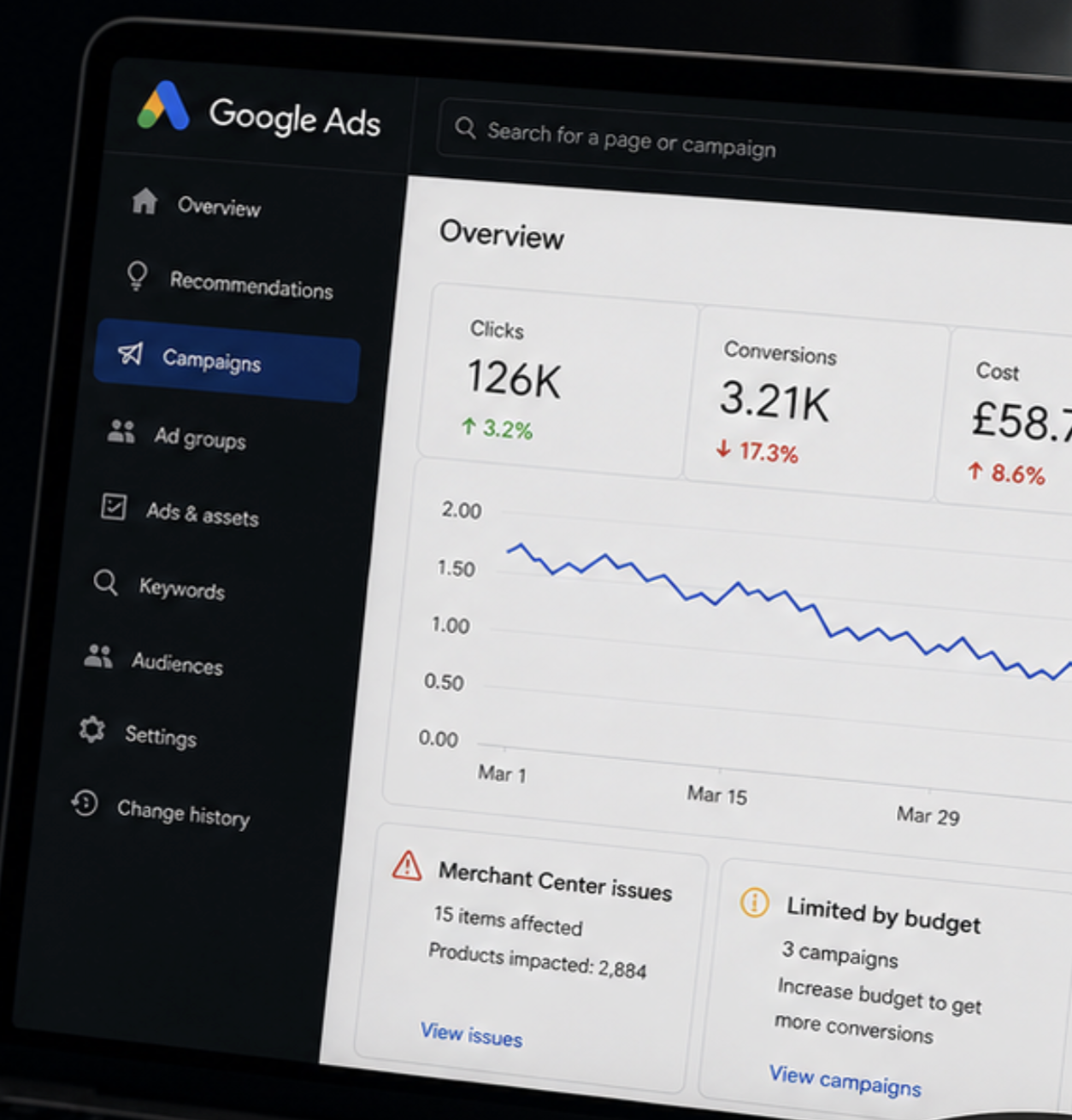
From the outside, the account looks alive. Spend is moving. Traffic is coming in. Conversions are still appearing in reports. Agencies send updates. Google shows green optimisation scores. The dashboard feels active enough to create the illusion that things are under control.
But underneath, the account is slowly drifting.
Search terms become broader month after month. Campaigns start prioritising cheaper traffic over better traffic. Product feeds weaken quietly in the background. Merchant Centre issues reduce visibility without triggering panic. Automated bidding systems adapt to whatever signals they’re given, even if those signals stopped reflecting real business value weeks ago.
Nothing breaks dramatically enough for someone to intervene.
And that’s exactly why performance slowly deteriorates.
Most Accounts Aren’t Strategically Bad
This is the strange part.
Most accounts we audit aren’t terrible because the original setup was wrong.
Usually, there was a decent structure at some point. Somebody clearly knew what they were doing in the beginning. Campaigns were segmented properly. Keywords made sense. Budgets were allocated logically. Search terms were tightly controlled.
Then the account was left alone.
Or partially managed.
Or handed between teams.
Or slowly absorbed into automation without oversight.
That’s when the decay starts.
Because Google Ads is not static anymore. The platform changes constantly. Search behaviour changes constantly. Auction pressure changes constantly. Automation shifts traffic constantly.
An account that performed well six months ago can become inefficient surprisingly quickly if nobody is actively steering it.
Google Rewards Attention
This is what most people misunderstand about PPC.
Google Ads isn’t won by the person with the cleverest hack. It’s won by the account receiving the highest quality attention most consistently.
That sounds boring compared to AI buzzwords and automation promises, but it’s true.
The best-performing accounts are usually the ones where somebody is:
reviewing search terms regularly
tightening targeting continuously
monitoring feed quality
reallocating budget aggressively
questioning what the algorithm is optimising toward
Not because Google is broken.
Because Google optimises for activity unless you guide it toward efficiency.
And there’s a difference between those two things.
The Quiet Damage Automation Can Cause
Modern automation has made this problem worse in a subtle way.
Years ago, badly managed accounts tended to fail loudly. You would see obvious mistakes quickly. Spend would spike. Click quality would collapse. Performance would become visibly unstable.
Now, automation smooths everything out.
That sounds positive — until you realise it also hides inefficiency better.
A campaign can slowly become less profitable over six months while still looking “healthy” inside the platform. Smart bidding adjusts. Performance Max redistributes spend. Broad match expands reach. The account keeps generating conversions, so nobody asks deeper questions.
But the business feels the difference long before the dashboard shows it.
Lead quality weakens.
Margins tighten.
Cost per acquisition creeps upward.
Sales teams complain that enquiries feel worse.
And because the decline happens gradually, it gets accepted as normal market behaviour instead of recognised as poor account management.
Merchant Centre Problems Are a Perfect Example
Merchant Centre issues are one of the clearest examples of this.
Most businesses don’t actively monitor product diagnostics. They assume products are serving unless something catastrophic happens.
But Google Shopping visibility erodes quietly.
Products become inactive.
GTIN warnings appear.
Pricing mismatches trigger limitations.
Feed attributes go missing.
At first, the impact feels small. A slight reduction in impressions. Slightly weaker click-through rates. Slightly less visibility in key auctions.
Then three months later, Shopping performance is down 30% and nobody can fully explain why.
The issue wasn’t one big failure.
It was dozens of tiny ones left unresolved.
The Search Term Problem Nobody Notices
Search terms drift in exactly the same way.
Broad match expands. Smart bidding chases volume. Search intent slowly moves away from what the business actually wants.
Not aggressively. Gradually.
A plumbing campaign that originally targeted emergency repair traffic starts appearing for educational searches, DIY queries, salary questions, informational content, and low-intent comparisons.
Google sees engagement.
The business sees weaker leads.
Those are not the same thing.
And unless somebody is actively filtering and refining traffic quality, the algorithm keeps learning from bad signals.
That’s how accounts become bloated without anyone noticing.
Why Some Businesses Think Google Ads “Stopped Working”
Most of the time, Google Ads didn’t stop working.
The account simply stopped being managed at the level required to keep performance efficient.
That’s a very different problem.
Because once inefficiency compounds long enough, businesses start assuming:
the market became too competitive
click costs are impossible now
lead quality has universally declined
PPC “doesn’t work like it used to”
Sometimes those things are partially true.
But very often, the bigger issue is operational neglect inside the account itself.
The Difference Between Stable Accounts and Stuck Ones
The highest-performing Google Ads accounts aren’t usually doing anything revolutionary.
They’re just maintained properly.
Search terms are reviewed before they become expensive problems. Budgets are adjusted before inefficiency compounds. Product feeds are strengthened continuously instead of treated as one-time setups. Conversion signals are validated regularly instead of blindly trusted.
Small corrections happen constantly.
That consistency compounds too.
And over time, the gap between well-managed accounts and neglected ones becomes enormous — even when both started with similar budgets, similar industries, and similar opportunities.
Final Thought
Most Google Ads accounts don’t collapse.
They decay.
Slowly. Quietly. Expensively.
That’s what makes poor management dangerous. It rarely looks dramatic enough to demand attention immediately.
It just holds businesses back month after month while the platform keeps spending.
And in Google Ads, what you fail to catch usually matters far more than what you actively optimise. If you want a set of expert eyes on your Google Ads before you hand more control to the algorithm, get your free analysis now.


