What AI Max Actually Does to Your Search Campaigns | PPC News
"AI Max sounds like a shortcut to better results — but handing Google the wheel without guardrails can drive your ad spend straight off a cliff."
Google keeps rolling out features that promise more performance with less effort. AI Max for Search campaigns is the latest. It sounds compelling — smarter targeting, broader reach, better conversions. But before you flip the switch, you need to understand exactly what you're giving up...
What AI Max Actually Does to Your Search Campaigns
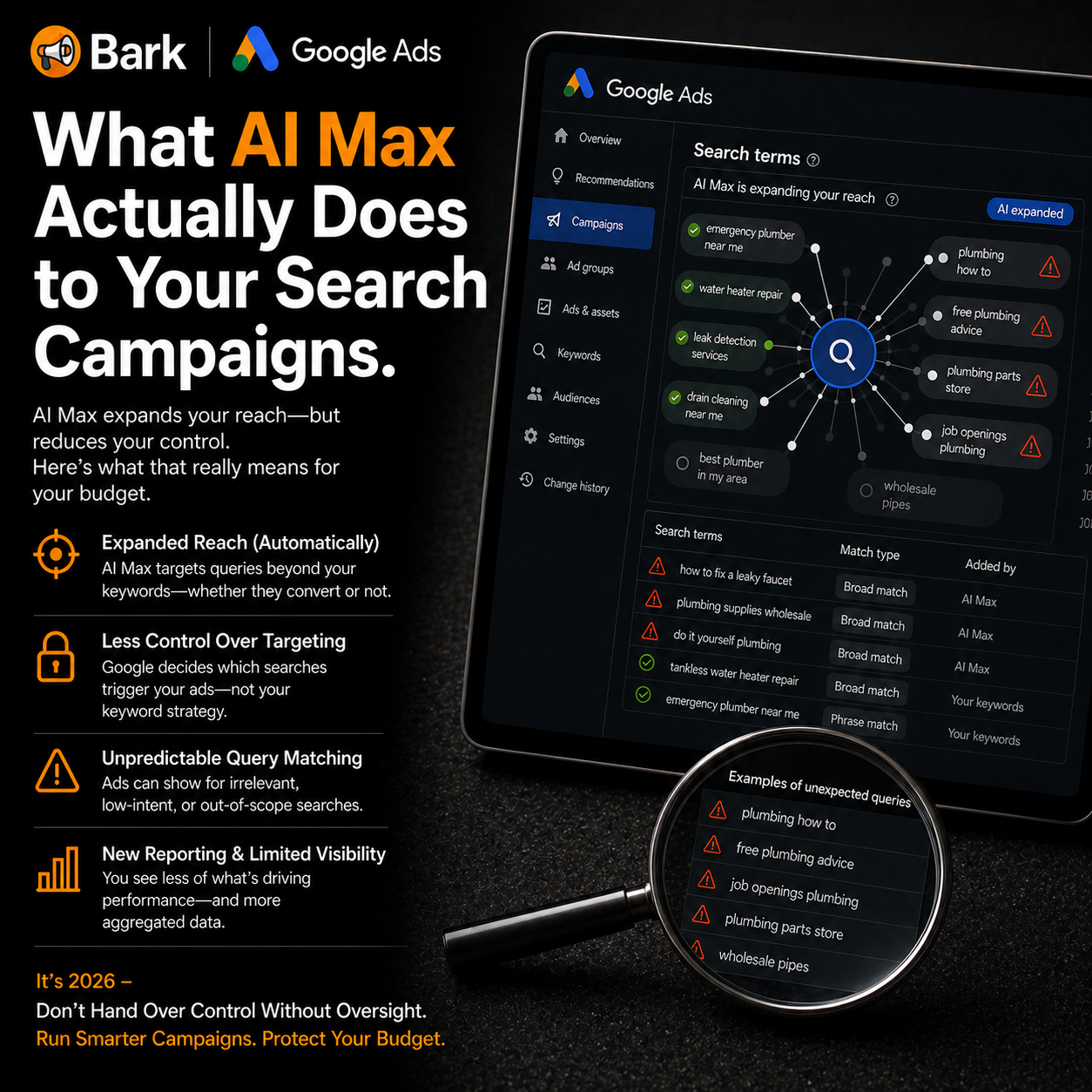
AI Max is Google's expansion of automation within Search campaigns. When you enable it, you're telling Google to go beyond your existing keywords and find additional queries it thinks are relevant to your business. On paper, that sounds like more reach. In practice, it means Google is making targeting decisions you used to control.
Your carefully built keyword lists, match types, and negative keyword structures become less decisive. Google's algorithm fills in the gaps — and those gaps can be very expensive. For local service businesses running tight budgets, that loss of precision isn't a minor trade-off. It's a fundamental shift in who's running your campaign.
The appeal is obvious. Broader coverage, less manual work. But broader coverage without oversight is just another way to burn money on clicks that don't convert.
AI Max Is Not the Same as PMax's Text Customisation — But Both Demand Your Attention
This is where a lot of business owners get confused, and it's important to get it straight.
AI Max and Performance Max are separate products with separate controls — but both carry real risks if you're not watching closely.
Within Performance Max campaigns, Google offers text customisation options and AI-generated asset features. These tools can automatically rewrite your headlines, descriptions, and even your business name to create variations it thinks will perform better. You might set up your messaging carefully — then find Google has quietly swapped in something different.
That's not a hypothetical. It happens. A plumber in Phoenix might have their business name displayed differently than they intended. A roofing company could see headlines that don't match their service area or offer. Without tight exclusions and regular auditing, your brand messaging is at the mercy of the algorithm.
AI Max sits in a different layer — it targets beyond your keywords in Search campaigns. But the principle is the same: Google is taking creative and targeting intent that was yours and making autonomous decisions with it. Know where each one operates and treat both with caution.
The Control You Hand Over When You Enable AI Max
Let's be direct about what enabling AI Max actually costs you in terms of control.
You lose granular oversight of query matching.
Google expands your targeting based on signals you can't fully see — search behavior, landing page content, user intent patterns. You're trusting the algorithm to interpret your business better than you do.
Your negative keyword lists become critically important — more so than ever. Without comprehensive exclusions, AI Max will serve ads on irrelevant queries, competitor terms, or searches that are adjacent to your service but will never convert. For a local electrician, that could mean showing up for DIY electrical searches, out-of-area users, or commercial queries when you only serve residential.
URL expansion is another area to watch.
AI Max can direct traffic to different pages on your site than the ones you specified — again, based on what the algorithm thinks is most relevant. If your landing pages aren't all optimized and conversion-ready, you're compounding the problem.
Exclusions Are Not Optional — They're Your Last Line of Defense
If you're going to test AI Max, exclusions aren't something you set once and forget.
They are the single most important control mechanism you have left.
Negative keywords need to be comprehensive, regularly updated, and reviewed weekly — especially in the early weeks after enabling AI Max.
Location exclusions matter just as much. AI Max's broader targeting can pull in users outside your service area if your geographic controls aren't explicitly set and enforced. For a local business, an out-of-area lead isn't just worthless — it's a wasted click that someone in your target market didn't get to see.
On the PMax side, if Google's AI asset generation is enabled, you need to actively review what's being generated and add asset-level exclusions where needed.
Check your automatically created assets regularly. If Google is rewriting your business name or generating off-brand descriptions, that needs to be flagged and restricted immediately — not discovered three months later when you notice your brand looks inconsistent across campaigns.
Only Run AI Max When You Can Prove It — and Control It
The rule here is simple:don't run AI Max speculatively. It's not a feature to enable because Google recommends it or because it sounds like it might help. It's a test — and like any test, it needs a hypothesis, a controlled environment, and a clear success metric before you start.
Run it with sufficient budget to generate meaningful data. Set a defined test window — 30 to 60 days minimum. Lock down your exclusions before you launch, not after. Monitor search term reports obsessively. And have a clear threshold: if cost per lead rises beyond a set point, you pause and evaluate before spending another dollar.
The worst thing you can do is enable AI Max, walk away, and check back in two months. By then, Google has spent your budget based on its own interpretation of your business, your messaging may have drifted across PMax AI features, and you're looking at a data mess that takes weeks to untangle.
This is not set-and-forget. It's set, watch, adjust, and only scale what's proven.
Don't Give Google More Than You're Ready to Lose
AI Max is a powerful tool in the right hands with the right safeguards. But for most local service businesses running lean ad budgets, handing over targeting intent to an algorithm — without airtight controls — is a risk that rarely pays off without expert oversight.
At Bark Media, we manage Google Ads exclusively for local service businesses. We know where AI features help and where they quietly drain your budget. If you're running AI Max already, or considering it, we can audit your setup and show you exactly what's working and what's costing you.
No guesswork. No jargon. Just a clear picture of what your campaigns are actually doing.If you want a second set of expert eyes on your Google Ads before you hand more control to the algorithm, get your free analysis now.


